
Author - Vinothkumar Srinivasan & Hukum Chandu Rokkala
For years, enterprises focused on data unification consolidating silos into a central lake or warehouse. That was the first step. But AI changed the game. AI agents don’t just need unified data.
They need organized, contextualized, and governed knowledge.
This is the shift: From “data in one place” to “data structured for intelligent reasoning."
With Microsoft Fabric, organizations can now move beyond storage and reporting toward a truly AI-ready platform powered by semantic models, governance by design, and the introduction of graph capabilities in Fabric.
The executive shift
Traditional modernization has typically emphasized centralized storage (data lakes/warehouses), standardized pipelines, BI dashboards, and self-service analytics.
These capabilities significantly improved visibility and reporting. However, AI agents require a more foundational layer. They don’t primarily “think” in rows and columns; they operate entities, context, and the connections between them.
That’s where graphs and ontologies become essential: they model relationships explicitly, establish shared meaning, and enable more reliable reasoning across data, systems, and workflows.
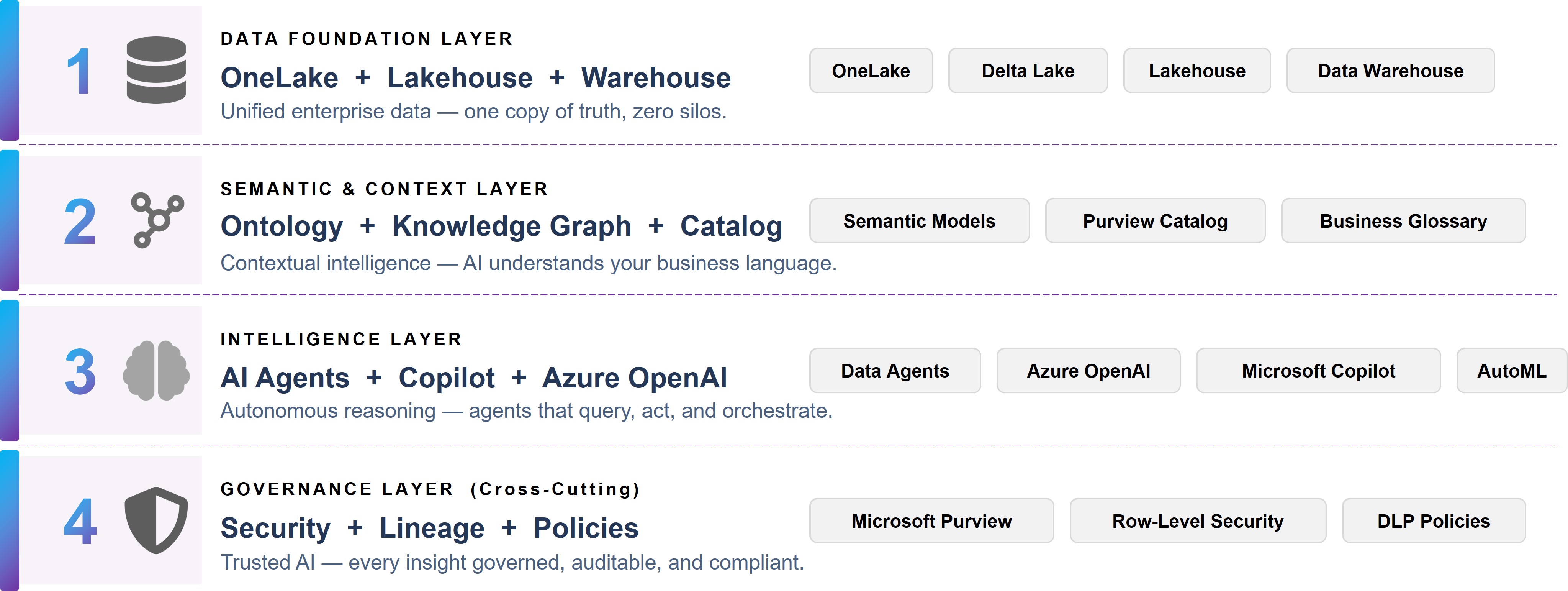
Graph operates in the intelligence and semantic layer, on top of OneLake (unified storage layer), Lakehouse / Warehouse (data foundation layer), Semantic models (business logic layer)
It acts as a context layer organizing data into a connected knowledge structure that AI agents can understand.
Graph brings relationship intelligence directly into the Fabric ecosystem.
Instead of treating data as isolated datasets, Graph enables:
- Modeling entities and relationships
- Connecting customers, products, policies, assets, transactions
- Powering AI agents with contextual awareness
- Enabling reasoning across domains
This enables: Multi-hop reasoning, Relationship discovery, Context-aware copilots, AI agents that understand business structures.
Here is a reference architecture for how the below components come together to form a cohesive solution.
Data agents: From insight to autonomous action
In an AI-ready Fabric architecture, agents can:
- Detect anomalies across connected entities
- Identify revenue expansion patterns
- Trigger risk alerts across relationship chains
- Recommend next-best actions
Example:
Instead of just identifying a drop in product sales, a graph-powered agent can detect:
- Which customers are connected to at-risk segments
- Which regions share similar behavioral patterns
- Which cross-sell relationships exist
That’s not reporting. That’s enterprise reasoning.
Ontology: The language layer for AI
In Fabric, ontology is implemented through semantic models, governed data products, and domain-aligned architecture.
This ensures:
- Consistent Copilot responses
- Cross-domain insight
- Reduced hallucination
- Explainable AI
Governance: Enabling Responsible AI at scale
AI readiness is not only technical, but also regulatory and ethical.
Fabric integrates governance capabilities across:
- Data lineage
- Role-based access
- Sensitivity classification
- Policy enforcement
When combined with Graph and semantic models:
- AI agents respect access boundaries
- Contextual reasoning remains compliant
- Decisions are traceable
Governance becomes an enabler, not a constraint.
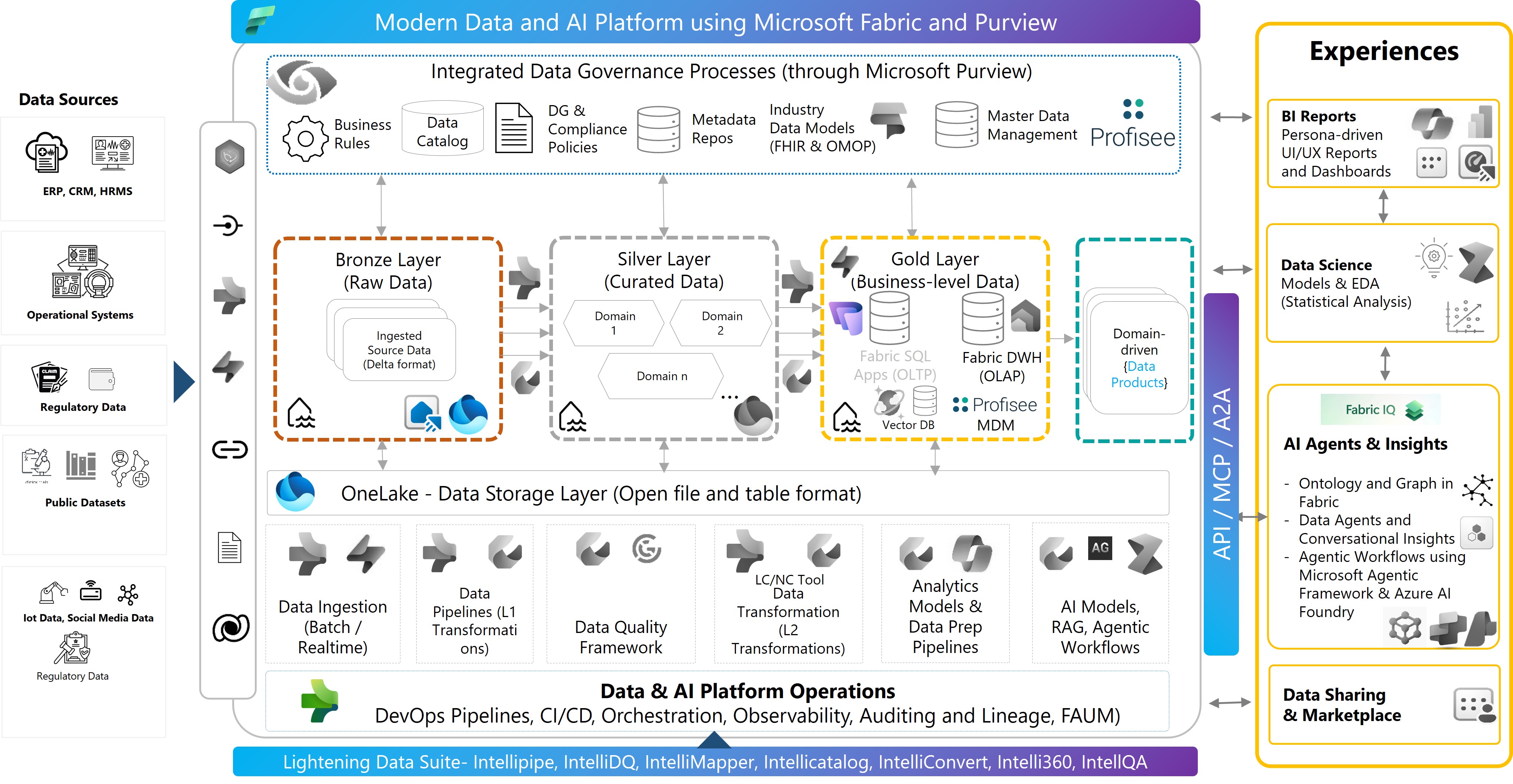
AI ready Microsoft Fabric stack
MS Fabric layered approach moves enterprises from:
“Can we see our data?” to “Can our AI understand our business?”
Microsoft Fabric provides the foundation for AI-ready enterprises unifying data, enabling Graph-powered context, embedding ontology, and enforcing governance by design. However, unlocking its full potential requires the right architectural vision and execution expertise. As a featured and launch partner for Fabric, Sonata brings deep experience in building contextual, agent-ready data platforms that move organizations beyond unification toward intelligent, governed AI at scale. Connect with us to accelerate your journey from modern data estate to true AI readiness.